
Underwater Hull Inspection for Ships in Egypt
Vessel hull, appendages and running gear surveyed afloat, with a position-referenced photo and video record built to survive class scrutiny
Suez-based team 18+ years' experience Response within 24 hours
A hull inspection is only worth what its record can prove. The dive is the straightforward part. What decides whether the job was useful is whether a class surveyor, a hull underwriter or a buyer's technical advisor can look at the footage six weeks later and agree on what they are seeing, where it sits on the ship, and how big it is. Almancy surveys vessels afloat at Suez, along the canal, in the Gulf of Suez, the Red Sea and the Egyptian Mediterranean ports, and the record is built from the first minute of the dive to be defensible rather than decorative.
Who reads the report, and what each of them is testing
A classification surveyor wants the information normally obtained from a docking survey. IACS Unified Requirement Z3 uses exactly that phrase, and it sets a high bar: the surveyor must be satisfied with the method of pictorial representation, with good two-way communication to the divers while the work is happening.
A hull underwriter or P&I correspondent is testing causation and extent. They need the damage located against the ship's structure, dated, and shown against sound steel nearby so the boundary of the claim is visible rather than asserted. A buyer's technical advisor is testing the seller's account: the gap between the coating condition in the specification and the coating condition on camera, plus anything nobody mentioned, such as an old doubler, a set-in plate or a repaired blade tip.
Those readers pull a survey in different directions. We ask which one matters most before the dive plan is written.
What makes an underwater record defensible
Orientation comes first. A photograph of corroded steel with nothing else in frame proves nothing, because the reader cannot place it. Class expects divers to be oriented on the plating using permanent markings at selected points, and flag guidance is more specific again: bead-welded marks identifying transverse and longitudinal bulkheads, longitudinal frame marks at intervals of around five metres, marked shell openings and docking plugs, numbered propeller blades. Plenty of ships carry some of this from a previous dock and nobody on board knows it is there. Where a vessel has none, we agree a temporary reference system with the owner and the surveyor beforehand, and every finding is tied to it by frame and strake.
Scale comes next. An indent means nothing without a dimension in the same frame, so a rule or graduated pointer appears in the close-up shot itself, not in a caption added later. UK flag guidance treats this as a running check: visibility and scale checks are to be made at intervals through the survey, not once at the start.
Then continuity. Stills are exhibits; continuous video is the evidence that they came from where the report says. The recording runs with diver commentary and a surface log, so the pass from bow to stern is one traceable sequence and any request made over the comms is on the record with its response. The diver's report is cross-referenced to that video, to the stills and to the shell expansion drawing, which is what flag guidance asks for and what weak reports quietly skip.
Last, honesty about what was not seen. The Bahamas Maritime Authority sets a better test than any bare number: a significant portion of the propeller or rudder should be clearly observed from a single view. UK guidance adds that surveys should be discontinued if visibility is generally below five metres. Alexandria rarely offers that. Nile-borne sediment, harbour traffic and an easily disturbed silt bottom regularly put working visibility into the low single metres, and a diver at arm's length from a plate can confirm coating condition without honestly certifying a whole strake. Our reports state which areas were examined at what visibility and which were not covered.
The hull and everything attached to it
Scope here is the vessel and its appendages. Survey of ports, pipelines and offshore structures sits on the underwater inspection page.
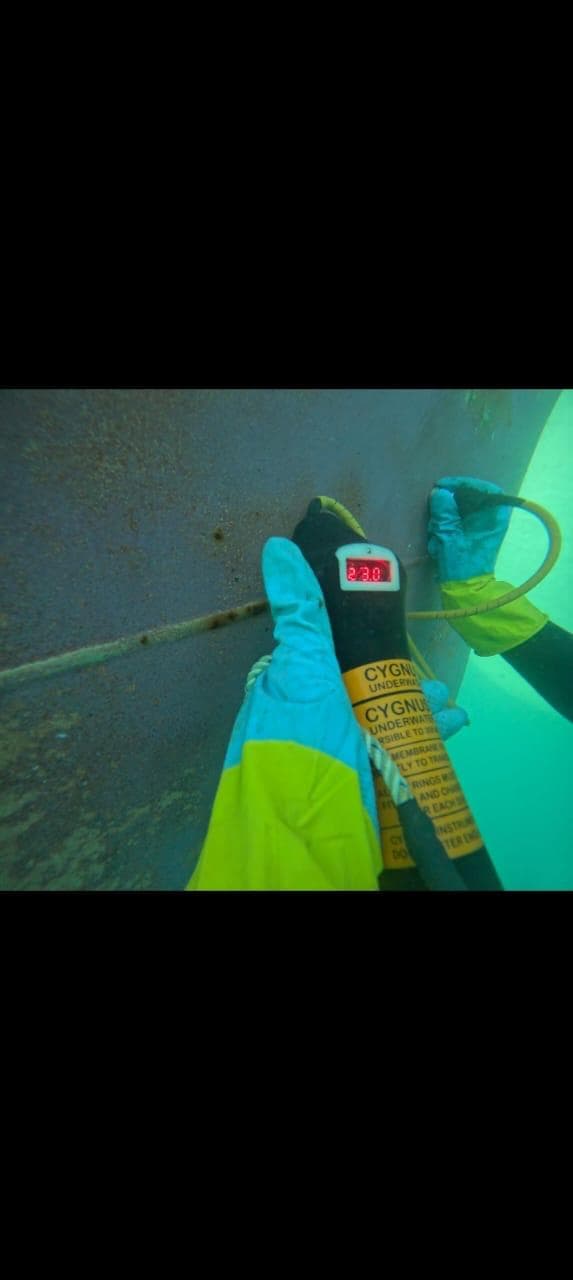
Ultrasonic thickness gauging and cathodic protection potentials are added where the scope needs numbers; the techniques are explained in our guide to underwater NDT methods.
- Shell plating and coating: corrosion, chafing and ground-contact deterioration, coating breakdown, unfairness and buckling, existing doublers and inserts. Unfairness that needs no immediate repair is still recorded, because the next survey needs the baseline.
- Weld seams, butts and previous repairs, examined close-up where the overview pass flags them.
- Boot-top, waterline band and flat of bottom. Flat of bottom is genuinely awkward afloat because of light and sight lines, so that pass is planned with the senior diver, never improvised.
- Bilge keels, and particularly the connection between bilge strake and bilge keel.
- Sea-chest gratings, sea connections and overboard discharges observed externally with their fastenings. Anything inside the chest belongs to sea-chest work.
- Bow and stern thruster tunnels, grids, blade condition and visible fastenings.
- Rudder, stock, pintles, gudgeons and stern frame, with rudder bearing clearances measured where the vessel is arranged for it.
- Stern tube, stern bush clearance, rope guard and shaft seal, supported by oil records and seal consumption where direct measurement is not possible.
- Propeller and running gear as observed: blade edge and tip condition, erosion, cavitation marking, hub and blade sealing on controllable pitch vessels.
- Anodes and cathodic protection, transducers, docking plugs, stabiliser fin boxes, A frames and P brackets.
In-water survey with class attending, and what decides acceptance
IACS UR Z3 requires at least two examinations of the outside of the ship's bottom in each five-year special survey period, one in conjunction with the special survey, with no more than thirty-six months between them. Examination is normally in dry dock, though a society may consider the alternate examination being carried out afloat as an in-water survey.
Consider is the operative word. Nothing about an in-water survey automatically satisfies a class requirement or replaces drydocking. Acceptance is the society's decision, taken with the flag administration, and what drives it is knowable in advance: vessel age (Z3 requires special consideration at fifteen years and over, and ESP tankers and bulk carriers of fifteen and over are to be examined in dry dock), open conditions of class on the underwater body, coating and anode condition, whether the ship is physically arranged for the measurements class wants, the survey site and its water conditions, and surveyor attendance. The survey firm itself has to be approved by the society as a service supplier under IACS UR Z17, with the work under a surveyor's surveillance. We confirm the approval and attendance position with the vessel's society before a job is booked, not after.
Two further honest points. If the survey finds damage requiring early attention, the surveyor may require drydocking anyway, so an in-water survey is a chance at avoiding the dock rather than a guarantee of it. And much of the preparation happens years earlier in the dock: markings applied, clearances recorded, hinged grid plates fitted, a coating chosen for contrast and for the extended period in water. Our guide to in-water survey and class requirements covers eligibility in more depth.
Damage, grounding, and buying or chartering a ship
After a grounding or a contact, the useful survey happens before the story hardens. Class is notified, an occasional survey follows, and the underwater examination establishes extent: affected plating located by frame and strake, indentation depth and area measured, the boundary between damaged and sound steel photographed, rudder, propeller and thruster tunnels checked for consequential damage. Masters are expected to keep a continuous record of actual and suspected contacts between dock and survey, and a diver's record that lines up with that log carries real weight when a claim is examined. Where the vessel is still operational or recoverable without a salvage award, the response sits with emergency response; where she is aground or sunk, it is salvage.
Pre-purchase and pre-charter surveys apply the same craft to a commercial question. A buyer's advisor is checking the specification against the steel, and an unexplained repair on camera moves a negotiation further than any opinion. On charter delivery and redelivery the value is a dated, position-referenced baseline of coating and running gear condition, so a fouling or blade-damage dispute months later starts from a photograph rather than two recollections. Findings are the inspection's output; the remedial work belongs to hull cleaning and propeller polishing.
How the work is carried out
- 1
Set the audience and the scope
We ask who has to accept the report: class, flag, an underwriter, or a buyer. That answer fixes the survey route, the measurements taken and the depth of the record, and it is agreed in writing before mobilisation.
- 2
Gather the ship's own evidence
Shell expansion drawing, existing hull markings, last docking and gauging reports, anode layout, clearance history, and the master's record of contacts since the last dock. Gaps surface now rather than in the water.
- 3
Choose the site and the window
Sheltered water, weak current and workable visibility decide the result. We assess berth or anchorage, draught and trim, tide window and daylight, and say plainly if the proposed location will not carry a defensible record.
- 4
Pre-dive meeting and isolations
An opening meeting with master, owner's representative, surveyor and dive supervisor covers the route, the permit to work, turning gear and rudder locking, pump and thruster isolation, and the emergency plan. Equipment is tested and the video link proved before anyone enters the water.
- 5
Survey with a live link
Divers work the planned route on surface-supplied equipment with continuous video, commentary and two-way voice, so the surveyor or superintendent can direct the inspection while the diver is still on the spot.
- 6
Report and correlate
Findings are written against frames, strakes and the shell expansion drawing, cross-referenced to video and stills, with observations kept separate from recommendations.
What you receive
- Written hull survey report, findings referenced to frame, strake and shell expansion drawing, observations separated from recommendations
- Annotated stills with a scale reference in frame at every defect
- Continuous survey video with diver commentary and surface dive log, supplied in full, not as an edited highlight reel
- Measured clearances where scope and vessel arrangement allow: rudder bearing and pintle, stern bush, plus recorded anode depletion
- UT thickness readings and CP potentials logged point by point against a structure diagram, where in scope
- A coverage and limitations note recording visibility on the day and any area conditions prevented examining
- A defect register in a form the next survey or dock can be correlated against
What we need to quote
The price of a hull inspection depends far more on what the record has to prove than on the size of the ship. Sending these gets you a real scope instead of a placeholder.
- Vessel particulars: type, length, breadth, expected draught and trim on the day, class society and flag
- Purpose: class in-water survey, flag requirement, damage or grounding assessment, pre-purchase, pre-charter or off-hire, or owner's condition monitoring
- Whether a class or flag surveyor will attend, in person or by live video link, and which society
- Date of last drydocking, coating system applied, anode layout and last renewal, and the last gauging report
- Existing hull markings, and whether a shell expansion drawing is available on board
- Any known or suspected contact, grounding or vibration since the last dock, and any open conditions of class on the underwater body
- Proposed berth or anchorage, expected fouling condition, and the operational window available
- Measurements specifically required: rudder and pintle clearances, stern bush clearance, UT points, CP potentials
Related Services
Hull Inspection: Frequently Asked Questions
Questions we are asked most often about hull inspection.
Does an in-water survey replace drydocking?
How much underwater visibility do you need?
Where in Egypt can an in-water survey actually be done?
Should the hull be cleaned before the inspection?
Can rudder pintle and stern bush clearances be measured afloat?
How long does a hull inspection take?
Start Your Project
Get a hull inspection scoped around who has to accept it
Send us the vessel, the location and the reader of the report, and we will come back with a survey plan, a realistic window and an itemised quote. For contact damage or a suspected grounding, the 24/7 line on +20 109 528 3400 reaches a supervisor directly.