Technical Guide
In-Water Survey in Lieu of Drydocking: Class Requirements Explained
An in-water survey (IWS) — also called an underwater inspection in lieu of drydocking (UWILD) — lets a ship's hull be surveyed by commercial divers while the vessel stays afloat. For eligible vessels, a classification society can credit it in lieu of one of the hull surveys it would otherwise require in drydock, saving the cost and downtime of a dock booking. This guide explains what an IWS covers, when class will accept it in lieu of drydocking, how often the hull must be examined, and how Almancy delivers class-compliant in-water surveys in Egypt, the Suez Canal, and the Red Sea.
Almancy delivers this work across Egypt, the Suez Canal, and the Red Sea.
Book a class-compliant underwater inspectionWhat is an in-water survey (IWS / UWILD)?
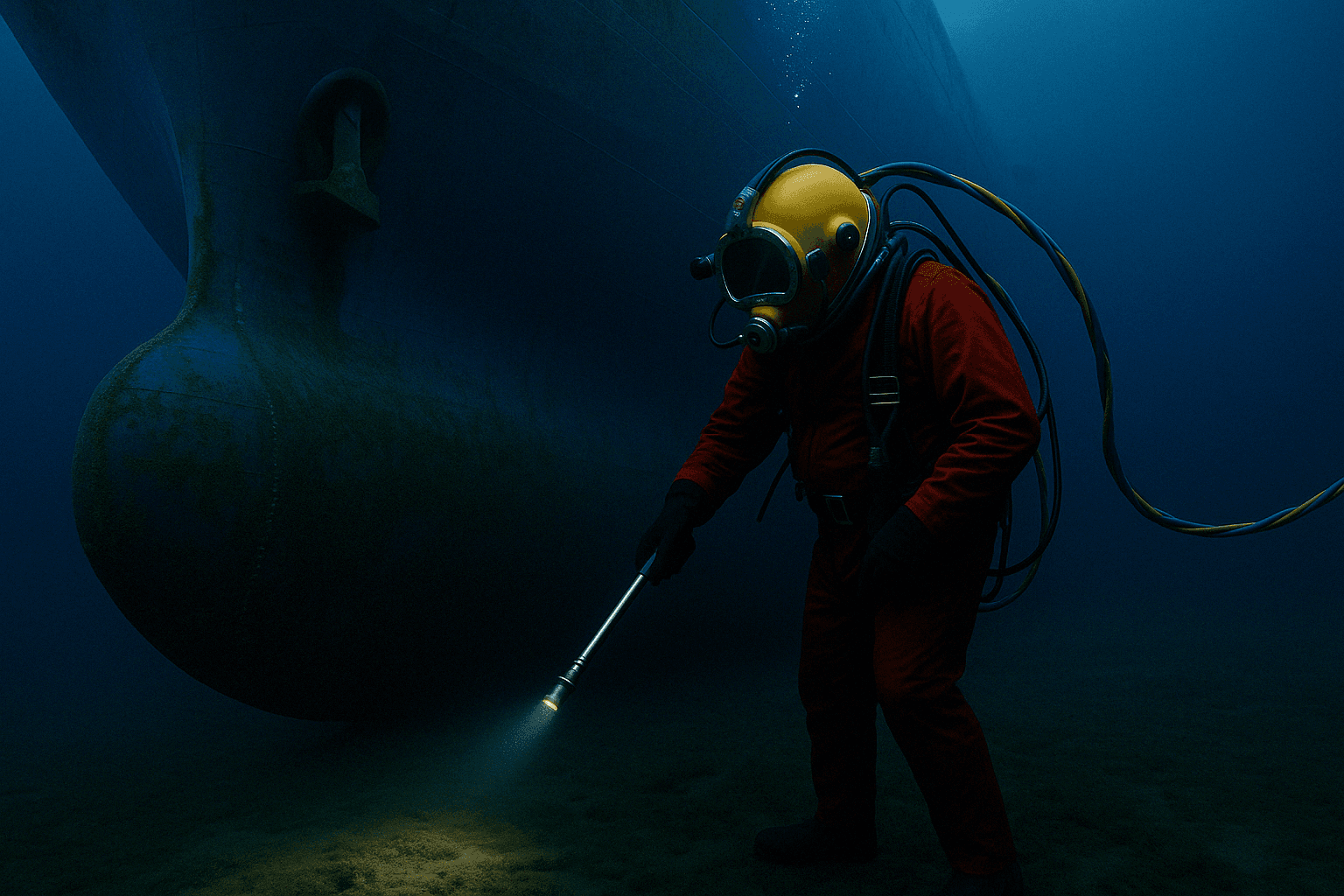
An in-water survey is a structured examination of a vessel's underwater hull and appendages, carried out by commercial divers with the ship afloat. The work is normally relayed to an attending classification surveyor through high-definition video and two-way communications, so the surveyor sees what the diver sees in real time and can direct the inspection.
Owners choose an IWS over a drydock examination to avoid the cost of a dock booking, the loss of trading days, and the scheduling pressure of finding a dock slot. When the hull coating and anodes are in good condition and the vessel qualifies, an IWS can give class the assurance it needs without taking the ship out of the water.
- Shell plating, welds, and previous repairs
- Sea chests, gratings, and overboard discharges
- Rudder, pintle, and jumping clearances
- Propeller, stern frame, and stern tube
- Tailshaft clearances where the survey scope allows
- Bilge keels and stabiliser fins
- Sacrificial anode condition and cathodic protection
- Coating breakdown and marine growth
Is in-water survey accepted by classification societies?
Yes — for eligible vessels, classification societies allow an in-water survey to be credited in lieu of one of the two bottom examinations required across a five-year survey cycle. Acceptance is conditional, not automatic: the society decides for the specific vessel, and the attending surveyor must be satisfied that everything normally verified in dock can be verified in the water.
The exact age limits and conditions vary between societies and ship types, so the rules below are a general guide. Final eligibility always rests with the vessel's classification society and flag administration.
- The vessel is within the society's age limit for IWS (often under 15 years for many ship types, but this varies)
- A classification surveyor attends, on board or via a live video link
- High-definition real-time video and two-way communications are provided
- Water clarity and diving conditions allow a thorough examination
- The hull coating and anodes are in satisfactory condition
- The survey is carried out by a diving firm recognised for in-water survey work
Class survey diving requirements
A class-compliant IWS is more than a swim-around with a camera. The dive team works to a planned survey route, referencing each observation to the ship's frames and strakes so findings can be located precisely afterwards. The team records close-up video of welds, coating condition, and any previous repairs, and measures the clearances the surveyor needs — typically rudder and pintle clearances, and tailshaft clearances where they fall within the survey scope.
Where the scope calls for it, divers carry out ultrasonic thickness gauging to confirm remaining steel in the plating, and a cathodic protection survey to check that anodes are still protecting the hull. These techniques are covered in our guide to underwater NDT inspection methods.
Almancy carries out this work diver-led, with the surveyor watching live. Where a survey needs to go beyond diver range, we arrange ROV survey through specialist partners rather than overstate an owned capability.
How often must a ship have an underwater hull inspection?
Under the standard survey regime used by IACS member societies, the outside of a ship's bottom must be examined twice within each five-year special-survey cycle, and the interval between those two examinations should not exceed 36 months. For eligible vessels, one of those two examinations can usually be an in-water survey in lieu of drydocking, while the other is carried out in dock.
Older vessels and certain ship types are treated more strictly. Ships beyond the society's age limit, and types such as passenger ships, generally have to be examined in drydock and cannot use an IWS to satisfy the requirement. As always, the precise interval and eligibility depend on the vessel's age, type, class, and flag.
In-water survey in Egypt, the Suez Canal, and the Red Sea
For vessels trading through or laying up near the Suez Canal, the Gulf of Suez, and Red Sea ports, arranging an IWS in-region avoids diverting to a distant drydock just to satisfy a survey. The hull examination can be planned around the vessel's schedule and carried out at anchor or alongside.
Diving in these waters requires coordination with the relevant port authority, and operations in the canal zone are carried out under Suez Canal Authority rules. Almancy is based at Port Tawfiq on the Suez Canal, which lets our teams mobilise quickly to vessels in the canal corridor, the Gulf of Suez, and the northern Red Sea.
How Almancy delivers a class-compliant in-water survey
Almancy's certified surface-supplied divers carry out in-water surveys to 50 metres, with high-definition video and a live link so the attending surveyor can direct the inspection in real time. We provide ultrasonic thickness gauging, cathodic protection surveys, and clearance measurements, and deliver an annotated report of findings and recommendations that owners can act on and surveyors can rely on.
We are an ISO 9001, ISO 14001, and ISO 45001 certified contractor and a member of IMCA and ADCI. We coordinate the survey with the attending class surveyor and the port or Suez Canal Authority, so the inspection is accepted and your schedule is protected.
Frequently Asked Questions
Can an in-water survey replace drydocking?
Is in-water survey accepted by classification societies?
How often must ships have an underwater hull inspection?
Is the survey carried out by divers or by ROV?
Where can Almancy carry out an in-water survey in Egypt?
Related guides
Talk to our team
Need underwater inspection in Egypt or the Suez Canal?
Send us your scope and timeline. Our diving team responds fast with a clear scope and a free, no-obligation quote.