
Sea Chest Cleaning and Underwater Sea-Chest Work in Egypt
Internal sea chest cleaning, grating removal, anode and strainer work, and blanking, under a written isolation agreement with the engine room
Suez-based team 18+ years' experience Response within 24 hours
Most of the difficulty in sea-chest work is not underwater. It is on the vessel, in the half hour before anyone gets wet, when the master, the chief engineer and the diving supervisor agree in writing which pumps stop, which valves shut, and who may take the tags off. A sea chest is a live opening into a ship's seawater system, and a diver at an intake that is not positively isolated can be held against the grating by a pressure difference far too large to pull free of.
Isolation is the job. The diving is what happens afterwards
Differential pressure, delta-P, is what separates a sea suction from any other underwater worksite. Force rises with the pressure difference and with the area of the opening: 0.1 bar across a square metre of grating is roughly a tonne of load pinning whatever is against it. UK HSE guidance records divers killed in three metres of water. Self-rescue is close to impossible, and rescuers entering the same flow have died attempting it.
The control is a proved hardware isolation the dive team physically holds, not vigilance. ADCI's ship husbandry guidance is blunt: before hull diving starts the supervisor meets the master or mate and the chief engineer, machinery with intakes is locked out including the main engines, and signed paperwork plus the supervisor holding the keys count as the only confirmation it was done. Sea chests are named on that lockout list.
Our permit-to-work with the vessel is deliberately dull:
Confirmation is separate from agreement for a reason. In one IMCA safety flash an automated trash-cleaning system recessed inside a seawater intake was never disclosed to the dive team, never isolated, and a diver's umbilical was drawn in and cut free by his standby.
- A pre-dive meeting with the master or officer of the watch and the chief engineer, worked from the vessel's own drawings.
- Written agreement on what stops, what shuts, what runs from the opposite side chest, and what stays live.
- Tags on the isolated valves and starters, keys held by the diving supervisor, so no restart happens without us.
- A check from the low-pressure side that flow has stopped and nothing can auto-start, then stop-work authority for anyone, held until every diver is out.
What sits inside the chest, and what goes wrong
Behind the grating sits a recess in the shell plating, connected inboard through a strainer plate and a ship's side valve to the cooling, ballast, fire and general service lines. Diver scope is the wet side of all of it.
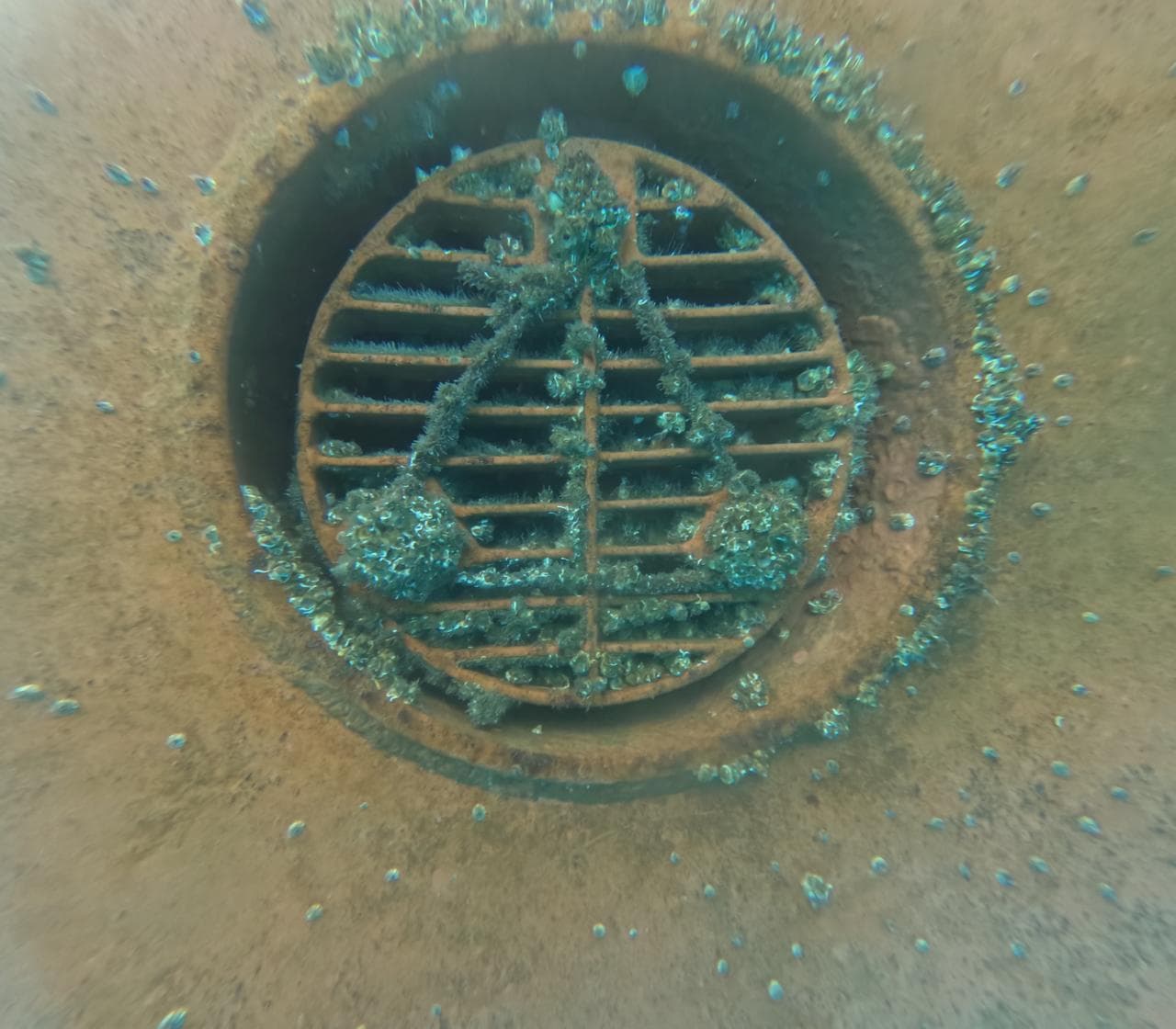
The trigger is usually one of two things. Cooling water flow has dropped and the engineers are chasing high temperatures, pump cavitation, or a strainer that chokes again within days; the published review of biofouling in ships' internal seawater systems records sea chest grates entirely covered in hard fouling, and a biofilm a millimetre thick halving heat transfer downstream. Or a ship's side valve is passing and cannot be opened with the sea behind it.
If a blocked intake is stopping the ship now, use emergency response rather than treating it as a routine planned visit.
- Gratings: removal, cleaning of bars and frame, condition of fixings and seating faces, refit with correct fasteners.
- The chest interior: hard growth, coating breakdown, weld seams, the suction bell mouth, and the low-flow corners where nothing sweeps settlement away.
- Debris: silt, shell, plastic, rope, weed. The strainer sits inboard, but what chokes it came through the chest.
- Anodes: sacrificial anodes on the box and grating frame renewed where diver-accessible, MGPS housings reported on from the wet side.
- Valve seat and surrounding steel seen through the opening, plus overboards, discharges and scuppers cleared or blanked.
Blanking a chest so the engine room can open it
A blanking plate is fitted over the grating opening or the overboard outlet from outside and sealed against the shell, so the chest and the pipework inboard can be drained and opened with the vessel afloat. Engineers can then lift the strainer plate, overhaul or renew the ship's side valve, or renew MGPS anodes from their inboard housings.
Almancy holds no stock blanking plates for particular ship classes and will not claim to. Blanks are vessel-specific, and the MCA's in-water survey guidance recommends that vessels carry customised blanks and record an agreed method of blanking off shell openings for diver safety. Where one must be fabricated, the sea-chest drawing is the starting point and the first thing we ask for. Without it, the diver measures up on a first dive and fabrication becomes a separate line in the quotation.
Repairs to grating frames, doublers or chest steelwork move to underwater welding. The class context is set out in what class expects from an in-water survey, and how to assess a diving contractor before award covers selection.
Why the chest fouls faster than the hull around it
The hull is a large coated surface that spends its life moving through water. A sea chest is the opposite: sheltered from flow, dark, permanently supplied with nutrient-rich water, full of corners and brackets where coating film thickness is hardest to achieve. IMO's 2023 biofouling guidelines treat sea chests as higher-risk niche areas for those reasons. Egyptian waters sharpen it, because accumulation starts the moment a ship stops moving and warm water accelerates it, which is exactly what waiting at a canal anchorage for a convoy slot amounts to. Alexandria and Port Said add fine silt, which does not grow on a grating but does reach the strainer plate.
External hull and boot-top cleaning belongs to hull cleaning, not to the internal chest scope. For a vessel-wide condition record, see the vessel hull condition survey.
How the work is carried out
- 1
Drawings and system review
Everything automated, including trash systems, MGPS and auto-start pumps, is identified from the shell and piping drawings, or it will not be isolated later.
- 2
Isolation agreement and permit
A meeting with the master and chief engineer fixes the boundary in writing, pumps stop, valves are shut and tagged, and the supervisor takes the keys.
- 3
Proving the isolation
Flow is confirmed stopped from the low-pressure side before any diver approaches, and both divers are briefed on the exclusion distance around the opening.
- 4
Grating removal and internal work
Gratings are unbolted, rigged clear and tended, then the chest is cleaned, cleared, filmed and assessed, and anodes are recorded.
- 5
Blanking and hand-over
Where the scope includes it, the blank is fitted and proved tight, then the chest goes to the engine room for draining under the same permit.
- 6
Refit and return to service
Blanks come off, gratings are refitted, a final swim confirms nothing is left in the chest, and only then does the supervisor release the tags.
What you receive
- Video and stills of each chest interior, before and after, with the grating removed
- A written condition record covering chest coating, weld seams, bell mouth and low-flow areas
- Grating and fastener report: bar condition, degree of occlusion, fixings replaced
- Anode inventory with wastage assessment and a renewal recommendation
- A debris log describing what came out, which matters when a strainer chokes repeatedly
- Ship's side valve condition from the wet side, recorded as an observation, not an overhaul finding
- The signed isolation and permit record, with tag times and the time the permit closed
What we need to quote
Sea-chest pricing turns on drawings and on which systems the ship can spare, not on tonnage.
- Sea-chest and shell expansion drawings: chest positions, dimensions, grating fixing pattern, sealing faces
- Which chests and outlets are in scope: high and low sea suctions, thruster intakes, discharges, scuppers
- Whether the vessel carries customised blanking plates, and if not, the drawing to fabricate them from
- Which systems must keep running, since that decides which chest can be isolated and for how long
- Vessel state and location: alongside, at anchor or at a canal waiting berth, draught, expected current
- Whether engine-room work follows the blanking, and how long they need the chest drained
- MGPS type if fitted, and the date anodes were last renewed
- Port, agent, and the status of diving permission from the port or canal authority
Related Services
Sea-Chest Work: Frequently Asked Questions
Questions we are asked most often about sea-chest work.
Can a sea chest be cleaned with the vessel afloat and the crew on board?
What is differential pressure, and why does it dominate this job?
Do you supply the blanking plates?
How long do the vessel's systems have to be down?
Will your divers replace the MGPS anodes?
Does sea-chest work satisfy a class requirement?
Start Your Project
Send us the sea-chest drawing
Tell us the vessel, the chests in scope and what your engineers need to reach, and we will come back with an itemised quotation and the isolation the master and chief engineer will be asked to sign. If cooling water flow is dropping now, call the 24/7 line on +20 109 528 3400.