
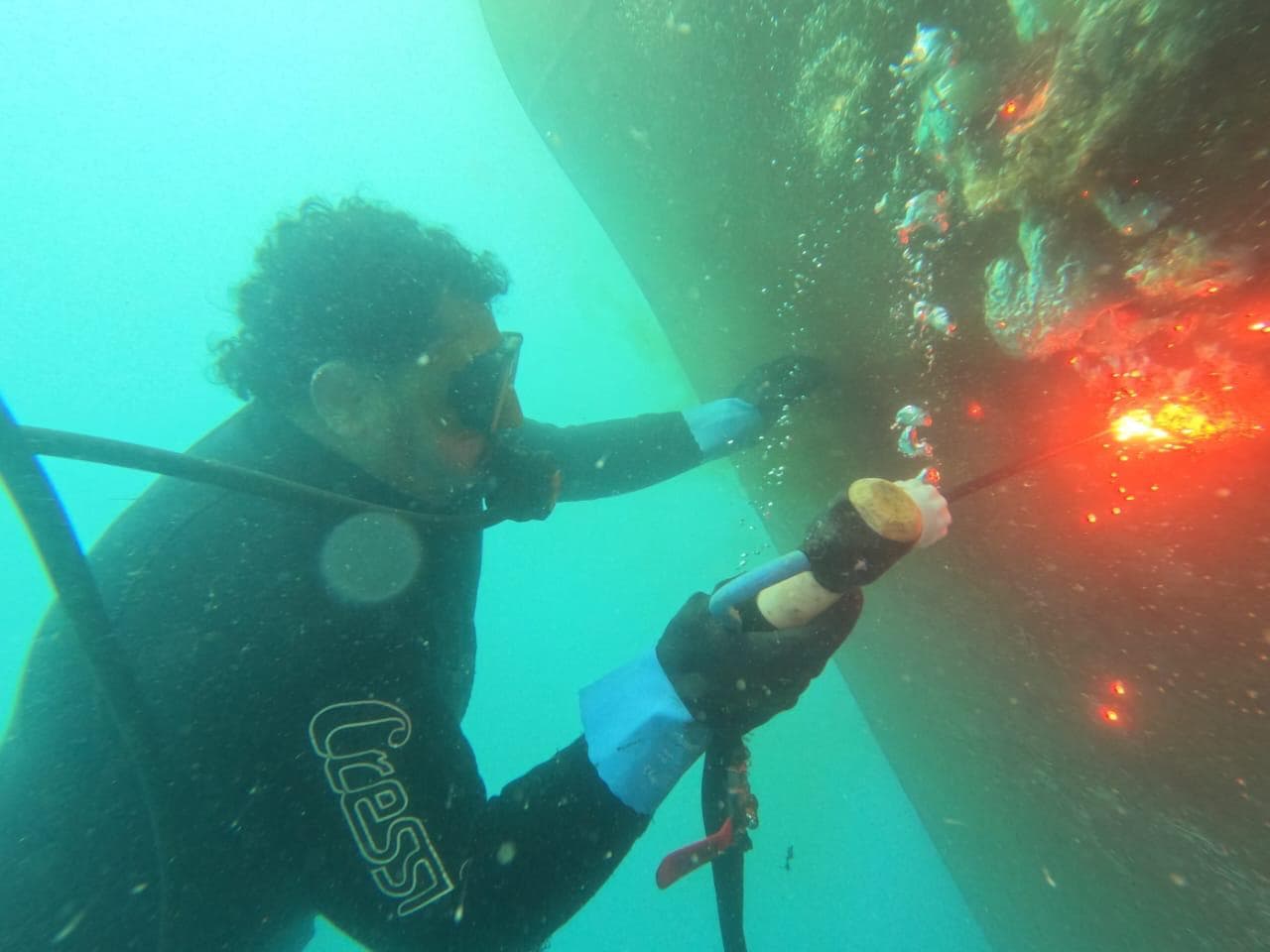
Emergency Underwater Response in Egypt and the Suez Canal
Rapid diver assessment and intervention when a vessel has a problem now: fouled propeller, blocked sea suction, contact damage, dropped object
Suez-based team 18+ years' experience Response within 24 hours
Two questions drive almost every call to an emergency diving line: how bad is it, and can the vessel move. Almancy answers a 24/7 line on +20 109 528 3400 from a base in Suez, close to the Canal corridor and within reach of the Gulf of Suez, the Red Sea, Port Said and Alexandria. What follows is written to be useful before you call rather than after: what a first dive can realistically establish, what information makes mobilisation faster, and where an intervention stops and salvage begins.
Work out which problem you actually have
The scope of the first dive changes completely depending on the answer. Read down this list and stop at the one that matches.
- Propeller, shaft or rudder fouled with rope, net, wire or cable. Divers cut and recover the entanglement, then inspect blade edges, the rope guard, the stern tube seal area and the rudder stock region. An IMCA safety flash on a mooring rope taken into a running propeller records damage to the propeller, rope guards and mooring equipment, with a far worse outcome had the stern tube seal gone. Clearing the rope is half the job. Confirming what it did on the way in is the other half.
- Sea suction blocked, cooling temperatures climbing. Gratings and strainers exist to stop debris, which makes them the first thing to block. Published survey data on internal seawater systems found significant biofouling in 34 per cent of 773 sea strainer inspections, and grate apertures of roughly 15 to 35 mm are easily bridged by plastic, netting, weed or jellyfish. Divers clear the grating face and establish whether the restriction is outside the chest or inboard of it.
- Contact or bottom touch, and you need the extent before you move. The dive establishes what is deformed, set up, cracked or missing, over what area, and whether watertight boundaries are intact.
- Something went over the side. Anchor and cable, a hatch cover, a spreader, a tool bag, a container, a section of cargo. Search and recovery, or at minimum a position fix so the owner and the port know where it is. Divers work to 50 metres on surface-supplied equipment; anything wider or deeper is arranged through partner-supplied survey capability rather than an owned ROV fleet, which we would rather state plainly than imply.
- A leak you can see. External sealing with soft patches, wedges, plugs or mechanical clamping can reduce ingress and buy time, with the method chosen on site against the geometry and plate condition. It is not a structural repair and it does not restore the boundary. If the fix has to carry load, it becomes a welded repair: see underwater welding.
- Aground and not coming off, sunk, capsized, or blocking a fairway. That is not this page. Go to salvage operations.
What the first dive establishes, and what has to happen before it
The first dive is an evidence-gathering exercise with an intervention attached, and it works best treated in that order. Divers record position, depth, visibility, extent and dimensions, plus a time-stamped photo and video record with a scale reference. That record is what the master, the owner, the hull underwriter, the P&I correspondent and the attending surveyor will all argue from later, and it is far easier to produce now than to reconstruct in three weeks. Where damage runs beyond what a visual can resolve, ultrasonic thickness gauging can be taken in-water on cleaned steel, which is a survey scope rather than an emergency one: see hull inspection.
Before any of that, the ship has to be made safe to dive on. Underwater ship husbandry kills divers through two mechanisms in particular: contact with live underwater fittings, and differential pressure. UK HSE guidance states that a risk assessment must assume a differential pressure hazard is present wherever water can be mechanically drawn through intakes or towards propulsors and thrusters. A live hull breach carries the same hazard, which is why the affected space is normally vented or equalised before anyone works outside it.
The practical consequence is a permit-to-work interface with the engine room before the dive, not during it. ADCI ship husbandry guidance mandates lockout and tagout and lists main engines, thrusters, sea chests, rudders and impressed-current systems among the sources to be isolated and physically restrained; a shut-down propeller still turns in a tideway. Almancy has been an IMCA member since 2015 and an ADCI member since 2012, and works to a job-specific risk assessment and dive plan on every mobilisation. If isolation cannot be confirmed, the dive waits.
How fast anyone can actually be in the water
Almancy runs a 24/7 line and mobilises from Suez, close to the Canal corridor. What we will not publish is a response time, because on this coast the number would be dishonest. Arrival is governed by:
Give the position, the berth or anchorage, the agent and the nature of the problem on the first call, and the mobilisation decision gets made in one conversation instead of four.
- Where the vessel is. Alongside at Port Tawfiq is a different problem from mid-Canal, a Gulf of Suez anchorage, or a berth at Alexandria.
- Access and clearance. Port entry, terminal permission, agent arrangements and boarding approval routinely take longer than the journey.
- Whether a boat is needed, and whether one can be chartered locally at that hour and in that sea state.
- Weather and current. Canal and anchorage current governs how long a diver can usefully work, and sometimes whether the dive starts at all.
- Visibility and daylight. Silt at Alexandria and a disturbed bottom after a grounding can reduce a survey dive to touch inspection, and a dive that produces no usable record is sometimes worth deferring a few hours.
Temporary repair, class, and the decision to sail
Owners are required to inform the classification society as soon as damage or a defect that may affect classification is found, and carrying out such repairs without requesting a surveyor's attendance can put class at risk. That duty sits with the owner, not the diving contractor. What a contractor supplies is the evidence the surveyor needs.
On temporary repairs the position is narrower than most people expect. IACS Unified Requirement Z7 provides that where damage is isolated and localised and does not affect the ship's structural integrity, the surveyor may give consideration to an appropriate temporary repair to restore watertight or weathertight integrity, and impose a Recommendation or Condition of Class with a specific time limit. Where a defect will impair fitness for continued service, remedial measures are to be implemented before the ship continues in service. A Condition of Class is a rectification deadline, not a clearance.
Nobody except the attending surveyor can tell you whether a temporary repair will be accepted, and a contractor who promises acceptance in advance is selling something they do not control.
Where emergency response ends and salvage begins
The line matters commercially, not just technically. Emergency response is a scoped job at agreed rates: clear the obstruction, assess the damage, seal the leak, recover the object. Salvage is a different legal relationship. Under Lloyd's Standard Form of Salvage Agreement the contractor agrees to use best endeavours to salve the property and take it to a place of safety, and the services are rendered and accepted on the principle of "no cure, no pay", with remuneration determined afterwards rather than agreed in advance.
If the vessel is aground and cannot be freed, sunk, capsized, or has become an obstruction, that threshold has been crossed. In the Canal this has a hard local edge. The Suez Canal Authority's Rules of Navigation provide that where a vessel runs aground, strands, sinks or is abandoned and the Authority deems it an obstruction or menace to navigation, the Authority may act of its own accord to remove or destroy it at the owner's risk and expense. The same Rules require a vessel whose machinery is or becomes disabled, or which is liable to become unmanageable, to be towed through the Canal. Losing propulsion in the corridor is not only an engineering problem.
Recovery of a casualty that has passed this threshold is covered on the salvage operations page, alongside completed work including the Cedar Queen tugboat recovery and the Arwi at Ras Sedr. Our marine salvage and wreck removal guide sets out the boundary in more detail.
How the work is carried out
- 1
Call and first facts
The 24/7 line takes position, vessel particulars, what happened, what has already been tried, and who is the point of contact ashore. This is the call that decides scope, so it is worth two extra minutes.
- 2
Desk assessment and mobilisation decision
Site constraints, access route, boat requirement and expected conditions are checked before anyone commits a time. You get an honest arrival estimate with its assumptions stated, and an update if those assumptions change.
- 3
Isolation and permit
Machinery isolation, lockout and tagout are confirmed with the engine room, along with sea suction status, thruster and rudder status, and cathodic protection. The permit is agreed and the dive plan briefed before the diver is dressed.
- 4
Assessment dive
Divers survey the affected area first, before disturbing it, and report to the surface live. Photo, video and measurements are captured against a known reference so the record survives later scrutiny.
- 5
Intervention within the agreed scope
Cutting and recovery of entanglement, clearing of gratings, recovery of a dropped object, or temporary sealing, carried out only after the extent is understood and the method is agreed with the vessel.
- 6
Handover and next steps
Written report to the master and owner, retained physical evidence where it can be recovered, and a plain statement of what remains outstanding for class, for the surveyor, or for a follow-on repair.
What you receive
- Verbal report from the dive supervisor to the master as soon as the diver is on deck, before any paperwork
- Time-stamped underwater photographs and video of the damage, obstruction or object, with a scale reference in frame
- Written dive report covering position, depth, visibility, extent, dimensions and the condition of adjacent structure
- Damage sketch or marked-up diagram of the affected plating, appendage or running gear
- Recovered material retained and photographed where recovery is possible, including cut rope, netting, wire or debris
- A clear statement of what was completed, what was not, and what remains unverified
- Recommended next steps to put to class, the surveyor or the hull underwriter, including whether a follow-on welded repair or a full survey is indicated
What we need to quote
Pricing is not what you need at 02:00, and it will not be the first thing we ask about. Have this to hand when you call and the scope, the mobilisation decision and the cost picture all get settled in one conversation instead of several.
- Vessel name, type, IMO number, flag and current draught
- Exact position: berth, anchorage, canal kilometre or coordinates, plus the local agent and the port or terminal contact
- What happened and when, including anything already attempted from on board
- Whether the vessel has propulsion and steering, and whether she is under her own power
- Whether the engine room can isolate and lock out main engines, thrusters, rudder, sea suctions and impressed-current systems, and who will sign the permit
- Your operational deadline: convoy slot, tide, charterer's laycan, sailing time or surveyor attendance
- Class society, whether class has been notified, and whether a surveyor is already attending
- Any drawings or previous survey material for the affected area, including general arrangement, shell expansion or sea-chest arrangement
Related Services
Emergency Response: Frequently Asked Questions
Questions we are asked most often about emergency response.
My propeller is fouled with rope and I am due to sail. Can you clear it?
I touched bottom. Do I need a survey before I move?
My sea chest is blocked and I have lost cooling. Can divers clear it alongside?
Will class accept a temporary repair so we can complete the voyage?
How fast can you get to my vessel?
Is this salvage? Will I be asked to sign a salvage agreement?
Start Your Project
Call the 24/7 line now
Almancy answers +20 109 528 3400 around the clock and mobilises divers from Suez to the Canal, the Gulf of Suez, the Red Sea, Port Said and Alexandria. Give us the position, the vessel and what happened, and you will get a straight answer on what the first dive can establish and how long it will realistically take to get in the water.