
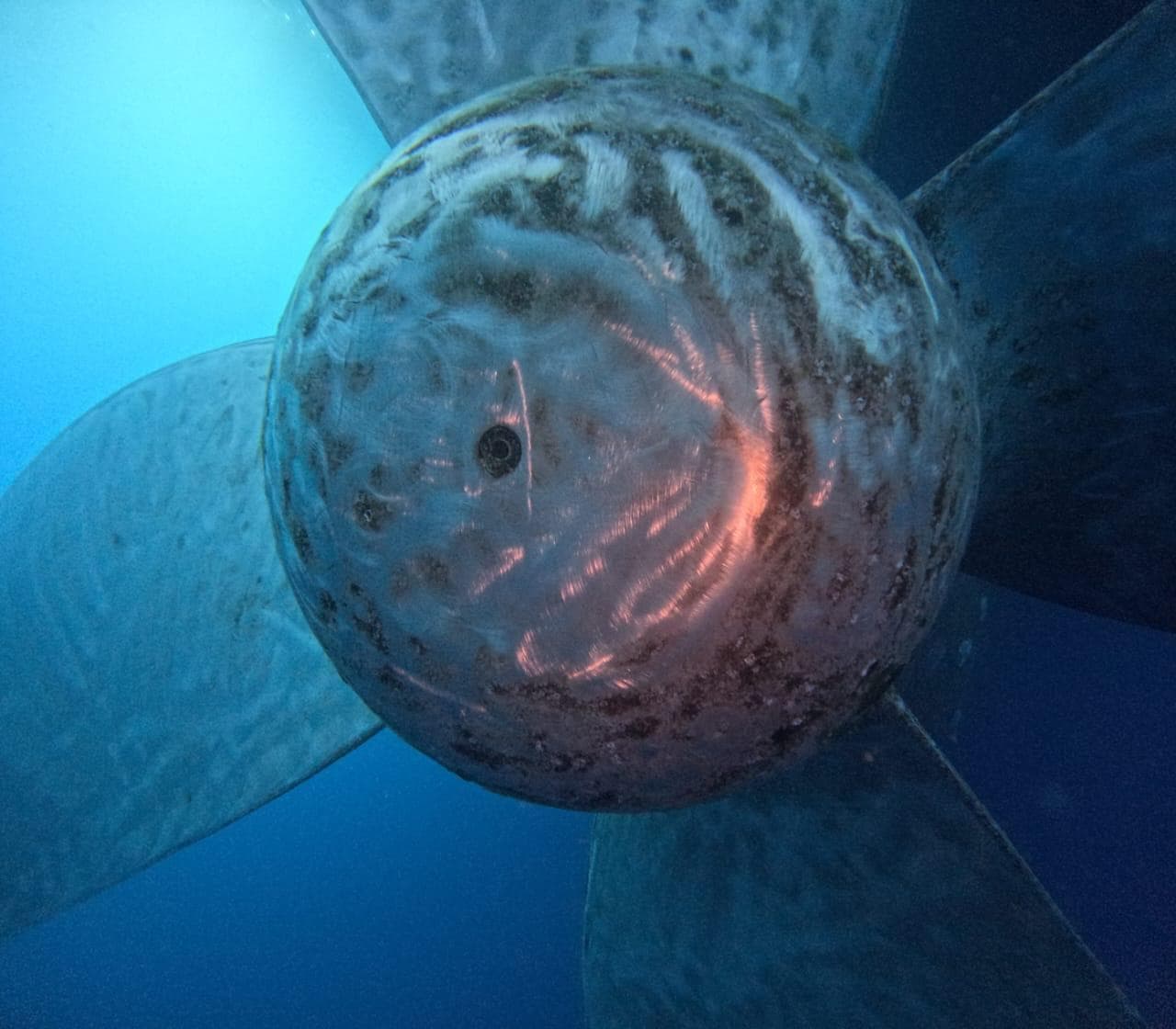
Underwater Propeller Polishing in Egypt
In-water polishing of bare non-ferrous blades, with the blade surface graded and recorded before and after the work
Suez-based team 18+ years' experience Response within 24 hours
A propeller is a precision non-ferrous casting that spends its whole life in seawater, and almost everything that happens to its surface shows up in the shaft. Fouling, calcareous deposit and corrosion roughen the blade. A rough blade drags. A blade attacked with the wrong abrasive by someone in a hurry stays rough for the rest of its service life. Almancy polishes propellers in the water at Egyptian ports and Suez Canal anchorages, and the part of the job that decides whether it was worth doing is knowing where to stop.
Why a rough blade costs power
Blade sections are lifting surfaces working in water. Roughening them raises the frictional drag of the section, so the propeller absorbs more torque for the thrust it produces and its open-water efficiency falls. That is not a sales argument. It is built into the standard model-to-ship performance prediction procedure used by naval architects, which carries a blade roughness allowance and corrects blade section drag for it.
What the mechanism does not give you is a number. How much you recover depends on how rough the blade had become, the propeller's design and blade area, the state of the hull it works behind, and how the ship actually trades. A contractor who quotes a fixed fuel-saving percentage before seeing the blade is guessing, and the guess is usually flattering.
IMO's SEEMP guidelines list propeller cleaning and polishing among the measures for fuel-efficient operation and say it may significantly increase fuel efficiency, without attaching a figure to it. They also ask owners to monitor efficiency quantitatively and judge whether a measure worked. Use your own noon-report data either side of the job. That is the only number that means anything on your vessel.
Grade the surface before touching it
Blade condition is assessed against replica comparator specimens, the set commonly used at sea being lettered A to F and spanning roughly one micron Ra at A up to about thirty at F. A and B represent new or reconditioned blades; C and below describe a blade that has been in service. Readings are taken at several radii on both face and back, not once at the tip, because a blade almost never wears evenly.
Grading also forces the useful distinction. Slime, shell and calcareous deposit sit on top of the blade. Impingement, cavitation erosion and corrosion are in the metal. The first comes off, the second does not come back, and the honest result of a polish is a smoother blade with its damage still on record.
The chalky film divers find is not only biological. A propeller bonded to the hull through a shaft earthing arrangement sits inside the vessel's cathodic protection circuit, and cathodically polarised surfaces in seawater accumulate calcareous scale. On a ship that has sat at anchor with the system energised, that scale can be the harder half of the job.
Grade discipline: taking deposit off, not metal
Work runs from the coarsest grade that will actually lift the deposit down through finer grades, and the finish is set by the last grade used, not the first. Skipping the fine stages to save bottom time leaves a scratch pattern rougher than the surface you started from. Grinding with discs that are too coarse can raise a blade's effective roughness instead of reducing it, and coarse cuts give marine growth a better key, so the blade fouls faster next voyage. Little and often beats one heavy pass every few years.
Edges are shape, not decoration. A leading edge rounded off or a trailing edge thinned changes where the section cavitates, so edges are dressed along their existing profile and never squared, rolled or blended into something the designer did not draw. Circumferential velocity and deposit are both highest at the tips, and so is the visible cost of a heavy hand. At the other end, the root fillet is the highest-stress region of the blade, which is why deposit is cleaned there and metal is not removed there.
The boss and fairing cap are cleaned and the cap fastenings checked. Nickel aluminium bronze depends on a thin adherent oxide film that reforms in seawater, so the target is a fair, even surface, not a mirror, and not a blade lighter than it was this morning.
Where polishing stops and repair begins
Cavitation pitting, leading-edge impingement, bent or torn tips, contact damage and cracks are not polishing work. Polishing a damaged blade smooths the area around the defect and leaves the defect.
The framework is worth knowing before you accept anyone's advice on it. IACS unified requirement W24 divides blades into severity zones A, B and C so the degree of inspection matches the criticality of a defect. Zone A carries the highest operating stresses: repair welding there is generally not allowed without special consideration by class, and grinding is permitted only to an extent that maintains the blade thickness of the approved drawing. In zone B a defect no deeper than local thickness divided by forty, or 2 mm, whichever is greater, may be ground out, and anything deeper moves into welding under a qualified procedure. Ground depressions are to be left smooth in contour so they do not become stress raisers or new cavitation sites.
Straightening a distorted blade is a hot operation at several hundred degrees, and cropping a tip changes diameter and balance on every blade, not one. Neither happens underwater. Where we find that damage we photograph it, dimension it, place it by radius and chord, and say plainly that it is a repair yard and class matter. The wider condition picture that goes with it belongs to a hull inspection.
Alongside, at anchor, and in the canal corridor
Nothing goes in the water until the propeller cannot turn. The supervisor meets the master and the chief engineer, every machine that can take suction is locked out and tagged, the main engine included, the shaft is physically restrained where current makes that necessary, impressed-current cathodic protection is shut down, keys stay with the supervisor, and the bridge announces that divers are in the water and that no propulsion, steering, suction, discharge or mooring movement takes place. Industry guidance on ship husbandry diving is blunt about why: flowing water will turn a propeller slowly, and passing traffic can spin one.
That matters more here than in a sheltered basin. Suez Canal anchorages and the Gulf of Suez put current across a stationary hull, the same condition that both fouls a blade quickly and makes it move. Warm water compounds it, since biofouling pressure rises with temperature and inactivity increases accumulation.
Because the diver is already at the stern, the same dive covers the rudder, the stern tube seal area, the rope guard and any wire or netting wrapped on the boss, all as observed and reported items. IMO's biofouling guidelines treat those as niche areas, and note that propellers are generally not coated but polished. Coating condition on the hull itself is a separate scope covered by hull cleaning.
How the work is carried out
- 1
Isolation and pre-dive meeting
The diving supervisor works through machinery isolation, lockout and tagout with the master and chief engineer, confirms the shaft is secured, and agrees bridge announcements and the permit before anyone enters the water.
- 2
Pre-work condition survey
The blades, boss, fairing cap, rope guard and stern tube seal area are filmed and photographed as found. Surface condition is graded at several radii on the face and back of each blade, and any damage is located by blade number, radius and edge.
- 3
Deposit removal
Slime, shell and calcareous scale are taken off with the coarsest grade that will lift them and no coarser, working blade by blade so that each is finished before the next is started.
- 4
Progressive finishing
Successively finer grades bring the surface down to an even finish, with edges dressed along their existing profile and the root fillet and any damaged area left alone.
- 5
Post-work record and handover
Condition is graded again at the same points, the same views are filmed, and the report separates what was improved from what was found and left for a repair decision.
What you receive
- Photo and video record of every blade face and back, before and after, with blade numbers visible
- Surface condition grading at the recorded radii, pre-work and post-work, so the change is documented rather than asserted
- A damage register locating any pitting, erosion, edge deformation or crack indication by blade, radius and edge
- Observations on the boss, fairing cap, rope guard, stern tube seal area and rudder seen during the same dive
- A written statement of what was cleaned, what was polished and what was deliberately not touched
- A plain recommendation on anything that needs a repair yard or a class-approved repair procedure
What we need to quote
Send us these and we can price the job properly instead of quoting a day rate against an unknown blade.
- Vessel name, IMO number and location, with the berth or anchorage and expected window
- Propeller diameter, number of blades, fixed or controllable pitch, and the blade material if known
- Date of the last polish or drydocking, and the trading pattern since then
- Any known damage, vibration complaint, or unexplained increase in shaft power or fuel consumption
- Recent hull and propeller photos or the last in-water report, if you have them
- Whether the vessel will be at anchor or alongside, and expected draught and trim at the stern
- Whether the vessel's crew can isolate and secure the shaft, and who holds the permit
- Whether a hull inspection or hull cleaning is wanted on the same attendance
Related Services
Propeller Polishing: Frequently Asked Questions
Questions we are asked most often about propeller polishing.
How often should a propeller be polished?
How much fuel will polishing save?
Can a propeller be polished at anchor, or does the ship need to be alongside?
Will polishing damage the blades?
What happens if a blade is cracked, bent or badly pitted?
How long does a propeller polish take?
Start Your Project
Send us the propeller details
Tell us what the propeller has been through and where the vessel will be lying. Back comes a scope, a dive plan built around the shaft isolation the ship will have to hold, and an itemised price. Vessels working to a canal transit schedule can reach a supervisor on the 24/7 line.