
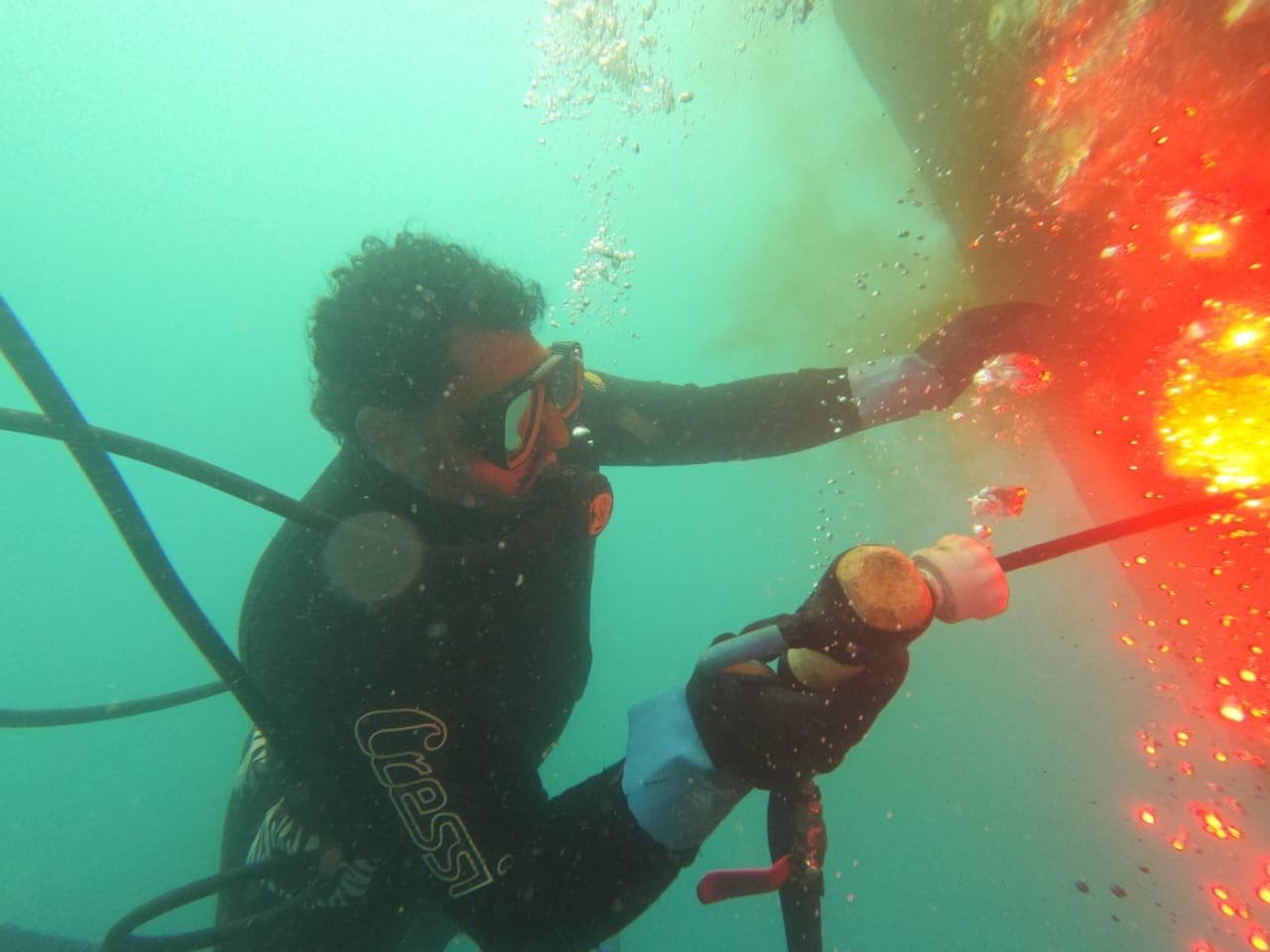
Port and Terminal Underwater Services in Egypt
Underwater condition surveys and maintenance support for operating berths, quay walls, fenders, mooring points, intakes and outfalls
Suez-based team 18+ years' experience Response within 24 hours
A quay wall rarely fails without giving notice first, and the notice is easy to miss from the apron. A pothole in the paving is often fill escaping through a hole in the sheet piling a few metres below the waterline; a fender panel a few degrees off vertical is a broken chain; a bed level at the toe that has dropped since the last survey is passive support quietly leaving the structure. Almancy works underwater on operating berths and coastal industrial facilities in Egypt, so a terminal engineer sees those things while they are still budget line items.
Level I, Level II and Level III, and why you should not pay for Level III everywhere
Underwater condition assessment of civil marine structures uses three recognised levels of effort, with the broader underwater inspection service covering method selection across asset types, and understanding them is the most useful thing a budget holder can take from this page.
A Level I inspection is a general visual and tactile overview with no cleaning. The diver swims the full exterior surface of every submerged element within arm's length, confirming the structure matches the as-built drawings and picking up obvious major damage, severe corrosion, scour and undermining. It is fast, it covers everything, and its other job is to aim the next two levels.
A Level II inspection is close-up work on a cleaned sample. Growth is removed from discrete test areas so the diver can see and measure what it was hiding: cracks, delamination, spalling, exposed reinforcement, section loss, pitting and abrasion. Cleaning is the expensive part, so it is restricted to elements that are structurally critical or genuinely representative. Waterfront and bridge inspection practice commonly sets that sample at a minimum of ten per cent of underwater elements.
A Level III inspection is non-destructive or partially destructive testing on a small number of members: ultrasonic wall thickness on steel, coring or physical sampling on concrete, hardness testing. It finds hidden or interior loss and establishes remaining cross-section, so it belongs only where the first two levels raised a question. The underwater NDT inspection methods guide covers the technique detail this page does not repeat. Running Level III across a whole berth is how an inspection budget gets spent without producing a better decision.
What we look at on the wall, and what each defect is telling you
Steel sheet piling and tubular piles are read by zone, because the failure modes are zoned. The band from roughly half a metre below mean low water springs down to the lowest astronomical tide is where accelerated low water corrosion appears, and it carries a signature a diver can recognise on sight. What matters is rate. A wall dimensioned against ordinary immersion loss can be years of remaining life short wherever ALWC has taken hold, which is why a suspected patch is scraped and gauged rather than photographed.
The same wall is also read for what is happening behind it. Holes and open seams mean backfill escaping. Deflection of the piling, or misalignment at connections, points at overstressed or failed tie rods and anchorages, which are buried and which underwater work reaches only indirectly.
Concrete is worked hardest in the splash and tidal zones, where wetting and drying drive chloride into the cover, corrode the reinforcement, and force cracking and spalling as the rust expands. Divers sound it with a hammer to find hollow areas that still look sound, then map them.
Cathodic protection is measured rather than judged. ISO 13174 sets the criterion for steel in aerated seawater at a polarised potential more negative than minus 0.80 V against a silver / silver chloride / seawater reference electrode, and more negative than minus 0.90 V where sulphate-reducing bacteria are active, which includes ALWC conditions. Anode consumption is recorded, with replacement normally at around eighty per cent consumed.
Fender and mooring hardware is checked from the water for what fails first. PIANC's fender guidance advises annual inspection as a minimum: cracks, over-compression, drooping units, panels out of vertical, loose or broken chains, missing fixings or facing pads, and a thorough inspection after any hard berthing or storm. Chains are replaced when corroded or reduced in diameter, not when they part. From the waterside we also record the concrete or steel carrying each bollard or quick-release hook. Proof loading and greasing stay with your own topside programme.
Depth at the berth, scour, and what is actually on the bottom
Terminals declare a depth alongside, and vessel acceptance depends on it. Divers confirm that declaration where it matters: least depth along the wall face and at the outer edge of the berth box, bed levels at the toe, and a tactile search for obstructions where a keel or a tug's skeg will pass. That is a confirmation exercise, not a hydrographic survey. Full-coverage bathymetry to an IHO S-44 order is a multibeam job Almancy does not carry out; diver work tells you whether the shoal patch it showed is rock, a settled block, or somebody's lost anchor.
Propeller wash is why the bed keeps changing. Vessel and bow thruster power have grown faster than the basins they work in, and PIANC's scour guidance for berthing structures exists because bed velocities at many berths now exceed what the bottom was built to take. Where rock or mattress bed protection exists, we check it for displacement, thinning and edge loss, since the layer fails at its edges first.
The rest of a berth bottom is debris: twistlocks, wire, dunnage, spreader parts, lost anchors, occasionally a container. Divers locate it, rig it and recover it. If the object is under a ship that cannot sail, that is not a survey any more, and our emergency response team handles it on the 24/7 line.
Diving on a berth that is still working
Almost every port enquiry comes with the same constraint: the berth cannot come out of service. The answer is to phase the work across the berth rotation and build coverage over several visits rather than ask for a closure.
Safety on a live berth is mostly about what is moving. IMCA guidance on diving in support of ship husbandry notes that propellers and thrusters can freewheel in a current, so physical restraint and confirmation from the bridge come before a diver enters the water near a berthed vessel, under the ship's permit-to-work. Ashore the same discipline applies with the harbour master: dive permit, signals, an exclusion around the dive site, a radio watch, and a stated point at which work stops for an inbound vessel.
Along the Canal corridor and at Gulf of Suez terminals, tide and stream decide the useful hours, so the programme follows slack water, not a shift pattern. At Red Sea facilities, containment of removed growth and coating debris goes into the method statement from the start. Where a vessel-side cleaning scope is needed, hull cleaning is the companion service.
Visibility is worth being honest about. At silt-laden Egyptian berths a purely visual survey establishes very little, which is exactly why recognised practice allows a Level I to be worked tactilely, by feel. A diver working by hand still finds undermining, major section loss, holes in sheet piling and missing components, and cleaning discrete test areas for Level II matters more here than it would in clear water. The report states which findings were visual and which were tactile.
Intakes, outfalls and planned shutdown support
Coastal power stations, desalination plants and terminal cooling systems share one weakness: the intake. Blockages come from growth on the structure and inside the culvert, barnacles and mussels through to sea squirts and hydroids, and from debris and siltation piling up against the racks. Loss of flow shows up as a derate long before anyone looks at the cause. Diver work here covers trash racks and bar screens, intake and outfall concrete and its edge protection, stop-log and gate guides, seal faces, and clearing of accumulated growth, silt and debris. It also covers fitting and removing blanks so internal work can happen dry, and that item needs the most care: a large aperture can expose a diver to differential pressure, so isolation is confirmed and locked out first.
Shutdown work is planned as programme, not as a callout, because underwater tasks in an outage sit on the critical path. The same logic applies to a berth: a baseline survey and then repeat inspections at the same reference points, with the same defect numbering. A one-off survey tells you the condition today. A programme tells you the rate, and the rate is what a budget is built on.
How the work is carried out
- 1
Records review and level agreement
We start from drawings, as-builts, previous survey reports and known history such as apron settlement, hard berthings and dredging records. From that we agree with your engineer which levels apply to which elements, the Level II sample size, and what would trigger a Level III test, so the cost is understood before anyone mobilises.
- 2
Permits and interface
Harbour master diving permit, terminal work permit, interface with any vessel alongside including thruster and propeller restraint, isolation of intakes where relevant, and an agreed procedure for suspending work for vessel movements.
- 3
Level I overview
A swim of the full submerged structure within arm's length, tactile where visibility does not allow otherwise, recording coverage element by element and marking the areas that need close-up work.
- 4
Level II close-up on the cleaned sample
Discrete areas are cleaned to sound material, then examined, measured and photographed, with each cleaned patch referenced so the same location can be revisited on the next cycle.
- 5
Level III testing where indicated
Ultrasonic thickness on steel and cathodic protection potentials at fixed stations, applied only to members the earlier levels flagged. Any coring, sampling or hardness testing is commissioned through the owner's consulting engineer or a specialist appointed for that scope.
- 6
Report and re-inspection plan
A defect register with locations, severity and recommended action, plus a stated view on what should be re-inspected and when.
What you receive
- Level I coverage record showing which elements were inspected and by what means, visual or tactile, with the conditions on the day recorded
- Level II close-up findings on the cleaned sample: measurements, photographs and video, with each cleaned test area located and referenced for repeat visits
- Level III results where carried out: ultrasonic wall thickness readings against original section, plus records supplied by any appointed specialist for sampling or hardness testing
- Cathodic protection potential readings at defined stations with the reference electrode stated, plus anode consumption estimates and replacement recommendations
- Bed level and least-depth readings along the berth face and at the outer edge, with the position of any obstruction found and a list of anything recovered
- Fender and mooring hardware condition record: panel alignment, chain condition and diameter loss, fixings, facing pads and missing components
- Defect register keyed to bay, pile or chainage with severity, likely mechanism and urgency, marked up on a drawing or berth elevation
What we need to quote
Port work is priced on structure type, access and how much of the berth we can reach between vessel calls, so a quote is only as good as the operational picture behind it. Send what you have of the following.
- Berth identity, structure type (steel sheet pile, tubular pile with relieving platform, block work gravity wall, open piled jetty) and the length to be covered
- Drawings or as-builts, plus any previous underwater survey reports and their dates
- Declared depth alongside, the datum it refers to, and the date of the last bathymetric survey
- The level of inspection you need and any element sampling already agreed with your consulting engineer
- Fender system type and installation date, and an inventory of mooring points, bollards or quick-release hooks to be checked from the water
- Cathodic protection system type, sacrificial or impressed current, and the last set of potential readings if you have them
- Berth utilisation and the realistic windows between vessel calls, plus who issues the diving permit on your side
- Anything already known or suspected: apron subsidence, a hard berthing, a lost object, a reduction in intake flow
Related Services
Port Services: Frequently Asked Questions
Questions we are asked most often about port services.
How often should a berth be inspected underwater?
What does a berth condition survey give me that I can put in a budget?
Can you inspect the berth without taking it out of service?
What is a berth box depth confirmation and why would a terminal need one?
What is accelerated low water corrosion, and how do you tell it from ordinary rust?
What happens when the survey finds something that needs repairing?
Start Your Project
Scope a berth survey against your maintenance budget
Send us the berth details and your last survey report. What comes back is a scope split by inspection level, so the budget line for the overview, the budget line for the cleaned sample and the testing that would only be triggered by a finding are all visible separately before anything is committed.