Technical Guide
Wet Welding vs Hyperbaric Welding: Underwater Welding Methods Explained
Underwater welding lets a damaged hull, pipeline, or structure be repaired without taking it out of the water, but not every underwater weld is the same. There are two very different methods — wet welding and dry hyperbaric welding — and choosing the wrong one can cost far more than the repair. This guide explains how underwater welding works, where each method fits, what the AWS D3.6 code means, and how Almancy delivers certified welding in Egypt, the Suez Canal, and the Red Sea.
Almancy delivers this work across Egypt, the Suez Canal, and the Red Sea.
Request certified underwater weldingHow underwater welding works
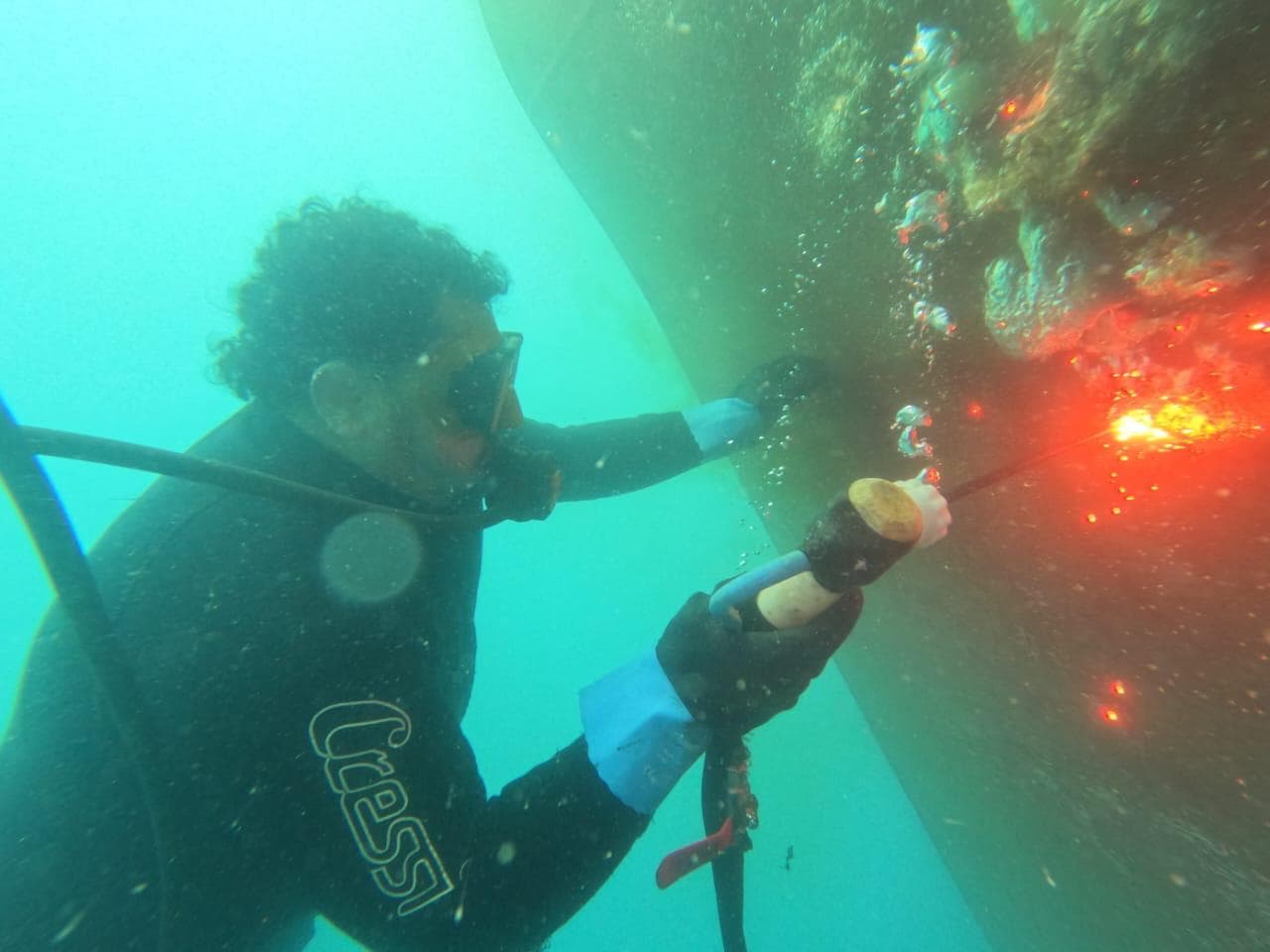
Most commercial underwater welding is wet shielded metal arc welding. An electric arc is struck between a consumable electrode and the workpiece, melting both so the molten metal fuses into a weld as it cools. The same physics used above water applies below it — the difference is the environment the arc has to survive.
To strike and hold an arc underwater, the electrode is coated in a waterproof layer, and the burning flux generates a pocket of gas bubbles around the arc that locally shields the molten weld pool from the surrounding water. The welder-diver controls the arc by feel and sight in low visibility, working with surface-supplied air and constant communication to a topside team.
Underwater welding is therefore as much a diving discipline as a welding one. The operator has to be both a qualified welder and a trained commercial diver, because the quality of the weld depends on hand skill, positioning, and judgement carried out in a far harder environment than a workshop.
Wet welding: fast, accessible, and best for temporary repairs
In wet welding the arc burns directly in the water with no barrier between the weld and the sea. Because the diver works straight onto the structure with a waterproofed electrode, wet welding is fast to mobilise, low in setup, and able to reach awkward locations that a sealed habitat could never enclose — which is why it is the workhorse for emergency and access-driven repairs.
The trade-off is metallurgical. Water surrounding the arc quenches the weld far faster than air, hardening the heat-affected zone, and hydrogen from the dissociated water is absorbed into the metal. Together these raise the risk of hydrogen (cold) cracking and generally produce a weld of lower integrity than the same joint made dry. For this reason wet welds are best treated as temporary or emergency measures, not as permanent structural fixes.
Used within its limits, wet welding is genuinely valuable — sealing a leak, securing a fitting, or fixing a patch or fillet to keep a vessel operating until a planned repair. The skill is matching the method to the job, not pretending a wet weld is something it is not.
- Strengths: fast to mobilise, low setup, reaches confined and awkward areas
- Best suited to: temporary and emergency repairs, fillet welds, patch plates, securing fittings
- Key risk: hydrogen cracking and a faster quench, which lower weld integrity
- Not appropriate as a permanent fix for primary structural or high-pressure connections
Dry hyperbaric welding: high-integrity, structural repairs
Dry hyperbaric welding removes water from the equation. A sealed habitat or chamber is built around the joint and filled with a gas mixture at the surrounding water pressure, displacing the water so the welder works in a dry, gas-filled environment against the dry surface of the steel.
Welding in gas rather than water avoids the rapid quench and the hydrogen pickup that limit wet welds, so the result is closer to a surface-quality weld — denser, tougher, and far better suited to structural and high-integrity work such as pressure-bearing connections and primary load paths. It is the method of choice when a permanent, code-quality repair is required.
The cost of that quality is complexity. A habitat has to be designed, fitted, and sealed to the structure, the atmosphere managed, and the operation supported by a larger spread. Hyperbaric welding takes longer to set up and demands more equipment than wet welding, which is exactly why method selection should follow the integrity the job actually needs.
Wet vs hyperbaric: a side-by-side comparison
The honest comparison comes down to integrity versus speed and access. Wet welding gets a competent diver onto a repair quickly; hyperbaric welding delivers a structural-grade weld but needs a habitat and more time. Neither is universally better — the right answer depends on whether the joint is temporary or permanent, and whether it carries primary load.
Use the points below to frame the conversation, then let the structural requirement, not the schedule alone, drive the decision.
- Speed and access: wet welding mobilises fast and reaches confined areas; hyperbaric needs a habitat built and sealed first
- Weld integrity: hyperbaric produces a higher-integrity, near-surface-quality weld; wet welds are lower integrity with hydrogen-cracking and fast-quench risk
- Typical use: wet welding for temporary and emergency repairs; hyperbaric for permanent, structural, pressure-bearing work
- Cost driver: wet welding is driven by dive time and access; hyperbaric is driven by habitat design, gas management, and a larger support spread (we quote each job individually, free of charge)
AWS D3.6 weld classes and qualification
AWS D3.6 (D3.6M), the Underwater Welding Code, is the standard that underwater welds are made and inspected to. It is a code of practice, not a badge a contractor is awarded — a reputable firm welds to AWS D3.6 standards using qualified procedures and qualified welder-divers, rather than claiming the code as an accreditation it holds.
The code sorts welds into classes by the integrity they must meet. Class A welds are intended to match the properties of an equivalent surface weld and suit structural, high-integrity applications. Class B welds allow for less demanding, lower-stress applications. Class O welds must meet the requirements of another code in addition to D3.6. Each class carries its own acceptance criteria for soundness, with hyperbaric work better placed to reach the most demanding classes than wet welding.
What matters in practice is that the welding procedure is qualified for the joint and class required, and that the welder-diver is qualified against that procedure. That qualification chain — procedure first, then operator — is what lets an owner or surveyor trust that a weld meets the standard.
Underwater cutting methods and how welds are inspected
Repairs often begin by removing damaged steel, and the common underwater cutting method is oxy-arc (exothermic) cutting. An exothermic or tubular cutting electrode burns at very high temperature, with oxygen fed through it to oxidise and blow away the molten metal, letting a diver sever plate, pipe, and structural members. Underwater cutting of this kind was used during the dismantling of the Shahd Cleopatra wreck.
A finished weld is only as good as the inspection that proves it. Welds are first examined visually for profile, undercut, and surface defects, then checked with non-destructive testing appropriate to the class. Ultrasonic testing (UT) probes for internal flaws and confirms soundness, while magnetic particle inspection (MPI) reveals surface and near-surface cracks in ferromagnetic steel.
Inspection ties straight back to the AWS D3.6 class the weld was made to: the higher the class, the tighter the acceptance criteria the weld must pass. These NDT techniques are covered in more depth in our guide to underwater NDT inspection methods.
- Underwater cutting: oxy-arc / exothermic cutting to remove and sever steel before repair
- Visual inspection: weld profile, undercut, and surface defects
- Ultrasonic testing (UT): internal flaws and weld soundness
- Magnetic particle inspection (MPI): surface and near-surface cracks
Underwater welding in the Suez Canal and Red Sea, and how Almancy works
For vessels and structures around the Suez Canal, the Gulf of Suez, and Red Sea ports, in-place underwater welding can keep an asset working without the diversion, dock booking, and lost trading days a drydock repair demands. The choice between a wet weld and a hyperbaric repair is made against the damage, the load the joint carries, and whether the fix is temporary or permanent.
Almancy's certified welder-divers carry out both wet and dry hyperbaric welding, working surface-supplied to 50 metres (we do not operate saturation diving). We weld to AWS D3.6 standards with qualified procedures, and pair welding with underwater cutting and NDT so a repair can be cut out, welded, and inspected by one team.
We are an ISO 9001, ISO 14001, and ISO 45001 certified contractor and a member of IMCA and ADCI, with 24/7 emergency response from our base at Port Tawfiq on the Suez Canal. That lets us mobilise quickly for an emergency wet repair, or plan a hyperbaric structural repair, across the canal corridor, the Red Sea, the Mediterranean, and Egyptian ports.
Frequently Asked Questions
What is the difference between wet welding and hyperbaric welding?
Is wet welding as strong as a hyperbaric weld?
What is AWS D3.6?
How much does underwater welding cost?
Can you weld in place to avoid drydocking?
Related guides
Talk to our team
Need underwater welding in Egypt or the Suez Canal?
Send us your scope and timeline. Our diving team responds fast with a clear scope and a free, no-obligation quote.